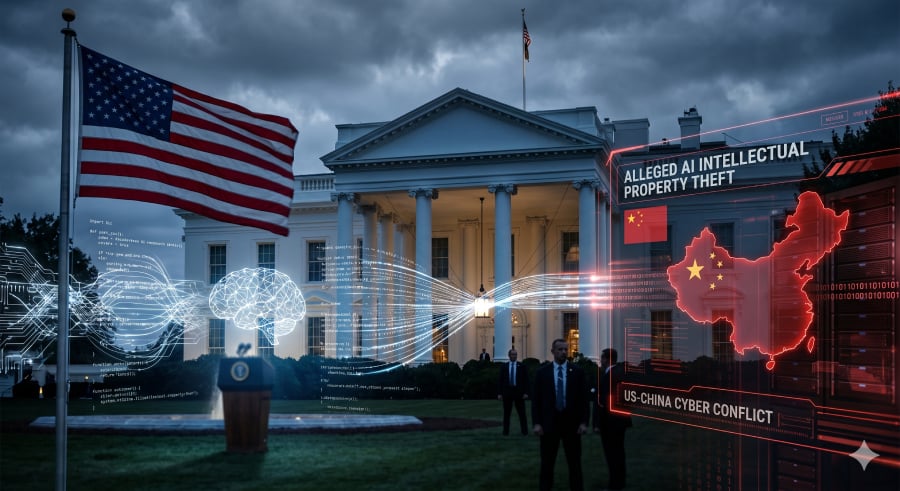
America’s AI race has a new problem as Washington says foreign actors are not just competing with US models, but trying to mine them.The White House is warning that China-linked entities are running industrial-scale distillation campaigns to extract American AI breakthroughs, with OSTP Director Michael Kratsios accusing foreign actors of trying to “steal American AI.” The memo turns model extraction into a federal policy and national security issue, with the US saying it will work with industry on defenses and explore measures to hold foreign actors accountable.Not one hack, but a grind The alleged playbook runs on volume.
The White House says foreign entities “principally based in China” are using tens of thousands of proxy accounts and jailbreaking techniques to slip past detection and extract information from American AI models.These campaigns are not described as a dramatic breach.They look closer to mass probing, with coordinated accounts hammering models for useful answers, behaviors, and capability patterns.
Distillation itself is not treated as the enemy.The technique can be useful when smaller models learn from larger ones through lawful access, especially when developers want cheaper systems that are easier to run.The accusation is that foreign actors are taking that method into unauthorized territory, using automated queries, proxies, and jailbreaks to pull value from US systems without permission.
Washington’s concern is scale.While a single smart prompt is ordinary use, millions of coordinated prompts can become a shortcut around the expensive research behind American AI and the safeguards that make it difficult to copy.More must-read AI coverage SS&C Intralinks DealCentre AI vs.
Datasite: Which platform is built for the future of dealmaking? Sovereign AI Explained: What Enterprises Need to Know Why Data, Not Models, Determines AI Success The Rise of the AI-Native Factory: How Physical AI Is Transforming Manufacturing Cheap copies can carry hidden cracks A copied model may look impressive on a leaderboard and still miss the parts that make the original safer and more reliable.Distillation can reproduce visible behavior, especially the kinds of answers that perform well in benchmark tests.But it may not carry over the full system behind those answers, including security controls, neutrality safeguards, and truth-seeking mechanisms.
A model can look capable in demos, then break under edge cases or adversarial prompts.That makes the theft claim about more than intellectual property.If a cheaper model spreads because it appears to match a leading US system, users may assume they are getting the same reliability.
They may not see what was lost in the copy.Kratsios drove at that risk in his X post, warning that foreign entities building on “such fragile foundations” should have “little confidence in the integrity and reliability of the models they produce.” Businesses, governments, and developers may feel the impact first.A model that borrows the surface of a stronger system without its protections can still write code, answer questions, and power tools.
It can also fail in ways people do not catch until they already depend on it.What began as lab claims is now a federal fight Before Washington weighed in, OpenAI and Anthropic had already raised the alarm.In January 2025, OpenAI accused DeepSeek of using knowledge distillation to improve its own models from OpenAI outputs, with earlier reporting in your reference citing “substantial evidence” behind the claim.
By February 2026, Anthropic said Claude had been targeted by “industrial-scale” distillation campaigns involving DeepSeek, Moonshot, and MiniMax.The company said the activity involved about 24,000 fraudulent accounts and more than 16 million exchanges, including prompts focused on coding, tool use, agentic reasoning, and evaluation-style tasks.Now the fight has moved from company claims to federal response.
The US says it will assess the national security risks, coordinate across agencies, work with industry on ways to detect and mitigate industrial-scale distillation, and explore measures to hold foreign actors accountable.The Pentagon’s $54 billion plan would make drones and AI combat systems a much larger part of future warfare.Subscribe to the Daily Tech Insider Newsletter Stay up to date on the latest in technology with Daily Tech Insider.
We bring you news on industry-leading companies, products, and people, as well as highlighted articles, downloads, and top resources.You’ll receive primers on hot tech topics that will help you stay ahead of the game.Delivered Weekdays Subscribe to the Daily Tech Insider Newsletter Stay up to date on the latest in technology with Daily Tech Insider.
We bring you news on industry-leading companies, products, and people, as well as highlighted articles, downloads, and top resources.You’ll receive primers on hot tech topics that will help you stay ahead of the game.Delivered Weekdays
Read More